
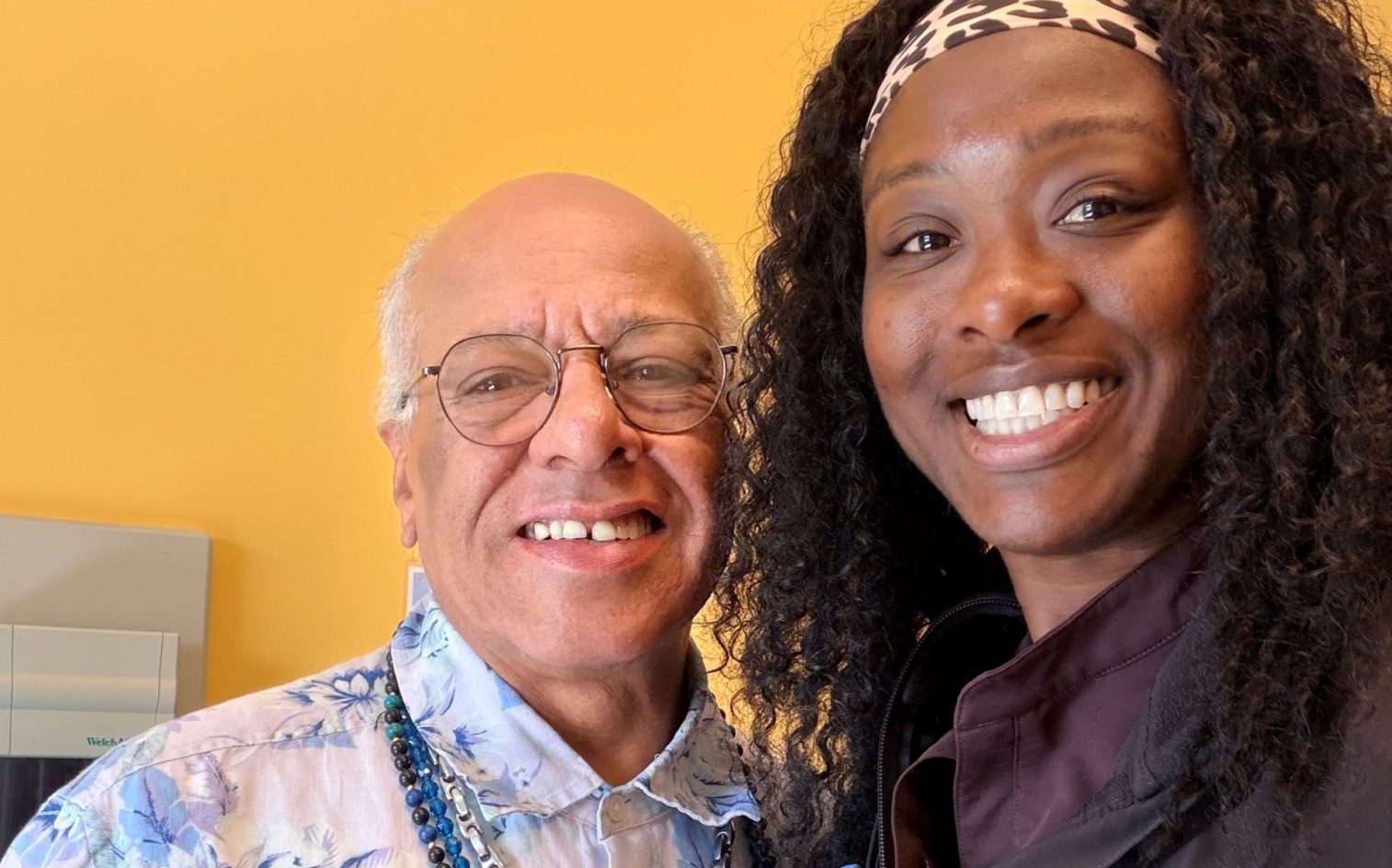
From living on the streets to spending the holidays with his family, Hopkins is the most content he’s ever been.
For the holidays this year, Craig Hopkins will head to the desert to spend time with his brother on their family land. It’s a tradition that stretches back to their childhood, and one that Hopkins is grateful he’s been able to resume in recent years. That’s because for most of the last decade, seeing his brother had been off the table. Hopkins had untreated mental illness, was using substances, and experiencing bouts of homelessness and incarceration. During that time, he and his brother had a fight that turned physical, and they became estranged.
“I just walked away from my family,” says Hopkins. “I was so isolated and depressed. But now, my brother and I are close again.”
Losing – and finding – a safety net
Craig Hopkins has a degree in anthropology from Cal Poly Pomona and previously worked in an Emergency Room. He experienced his first psychiatric break while in college, and was later diagnosed with bipolar, depression and eventually schizoaffective disorder. Substance use led to him losing his ER job, and he first became homeless in Venice in 2013. For the remainder of the 2010s, he was able to live in temporary housing and then with his mother for a time, but he found himself back in a tent on Venice Beach in 2020 after staying with her was no longer an option.
At that point, he had no other family to turn to. Fortunately, that’s when he found Venice Family Clinic. Or rather Venice Family Clinic doctor of nursing practice Ebony Funches found him.
“I made a conscious choice to be his Primary Care Provider,” Funches says, reflecting on her first meeting with Hopkins on the beach. Hopkins was opening up to her about his history. He connected with her enough to accept an injectable, long-lasting medication for schizoaffective disorder, and Funches wanted to ensure he’d be able to keep taking that as well as get other care. She knew that providing Hopkins with a consistent contact is what would really “help Craig get back to being Craig,” as Funches put it. The regularity with which she saw him and answered his calls paid off: “He started to trust me,” she says.
A wake-up call
Funches would visit Hopkins regularly on the beach or see him for appointments at the flagship on Rose Avenue. She also connected him to a case manager, and together they worked to place Craig in interim housing, including helping him gather the necessary documents, which had previously all been lost or destroyed.
Interim housing ended up being a blessing and a curse. He was off the street and sheltered from the elements. He was also able to get sober because he’d only been using substances when the opportunity presented itself – drugs were not something he sought out.
However, he was also isolated because he was fearful of the other residents. He lapsed on his medication, hallucinations returned and his health and hygiene went downhill.
A turning point in Craig’s story came after a Venice Family Clinic case manager arranged for a ride to make sure Hopkins made it to an appointment with Funches. At that appointment, Funches became concerned about his health when she saw that he had lost a dramatic amount of weight. She ordered a full medical workup and discovered Craig had an aneurysm and the beginnings of emphysema. She referred him to specialists and he began taking medication and addressing lifestyle factors that would prevent his conditions from worsening.
Funches had also noted the significant toll loneliness and fear were taking on his life, causing him to become depressed. Funches prescribed him antidepressants, which enabled him to take action in a way he hadn’t been able to before – enrolling in benefits, getting a cellphone and willingly starting therapy.
Going the distance
Funches’ diagnoses had been a wake-up call for Hopkins. Even so, because therapy and medication had been viewed as a sign of weakness in his family, it wasn’t easy for him to accept this type of help. But once in therapy, Hopkins began to do the inner work that led him to realize how important his family was to him.
“My brother is coming around now to recognizing the importance of treating mental health disorders like any other illness,” Hopkins says. Eventually, his brother consented to join him in family therapy where they have been working to repair their relationship. Now Hopkins gets an express bus voucher from his Venice Family Clinic case manager so he can make the long journey to see his brother every two weeks.
Funches also continued to care for Hopkins’ body and soul. His homelessness had left him with PTSD, and the years he’d spent using substances and living on the street left him vulnerable to chronic disease.
“We wanted to ensure that once he was housed, that he continued to live a healthy life, and could really make the most of his housing to the best of his ability,” Funches says.
Home at last
After four years in temporary housing, Hopkins’ application for permanent housing was finally approved. He says that cooking his own food, living on his own, sleeping on clean sheets, taking showers, and managing all his health care and benefits appointments makes him feel proud of himself. In fact, it’s the most content he’s ever felt.
Funches too sees the work they’ve both put in paying off.
“I’ve seen him grow tremendously,” Funches says. “Where he is today is night and day from where he was before.”
Ahead of Thanksgiving while on his way up to see his brother, Hopkins reflected on how much had changed in his life, and what being able to spend the holidays with his family meant to him.
“It makes me feel hopeful,” Hopkins says. “When I was there last time, I was telling my brother how happy I was. Without Venice Family Clinic, I never would have gotten housing. I never would have gotten any of this. Now, I know I have a real future.”