
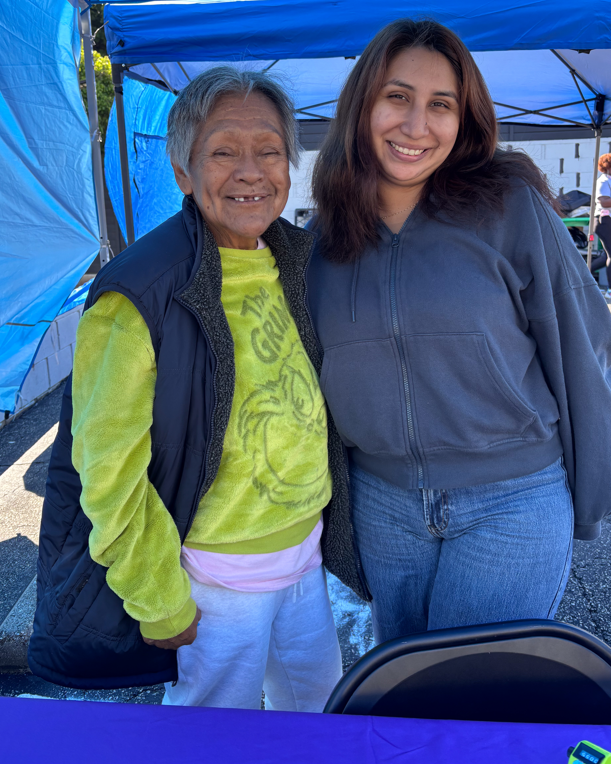
Food program health educator Montse Lara begins setting up free food markets at 6 a.m. Multiple mornings per week, one of the first faces she’ll see belongs to volunteer Arminda López, who always greets her with a smile and, often, breakfast pastries for the team.
“For Arminda to be able to share her stories with us, for her to come and volunteer with us, is one of the greatest gifts that the universe has sent me,” Lara says.
López is a long-time resident of Santa Monica and patient at Venice Family Clinic’s Simms/Mann Health and Wellness Center. In addition to receiving medical care with the Clinic, she became a volunteer four years ago when López got news that shook her life.
She learned she had Stage IV cancer, present in multiple parts of her body. The diagnosis brought up a tidal wave of memories and emotions. López lost her 15-year-old son to an act of violence 20 years ago, and with the cancer diagnosis, the grief came rushing back.
“I thought maybe the cancer meant he wanted me to come and join him,” López says.
Grappling with her own diagnosis and the resurfacing trauma of losing her son, López began seeing Venice Family Clinic therapist Miranda Harwood, LCSW. Harwood urged López not to give up on her life and suggested one way to stay afloat: volunteering.
“She said get outside, stay busy, be with people,” López says. “It makes me feel so good.”
The balm of human connection
Volunteering has been proven to reduce depression, especially among older adults. Having a sense of purpose and connecting with others can bolster mental health in multiple ways.
“Having somewhere to go during the week, where you will socialize with others and provide a service that helps people can reframe a person’s sense of self and their identity outside of any mental health or medical condition,” Jennifer Amaya Gonzalez, LCSW, Venice Family Clinic associate director of behavioral health says. That has been the case for López. Even while undergoing chemotherapy, she arranged her appointments so that she would not miss a day volunteering at the Rose Avenue and Irma Colen Health Center fresh food markets. She loves to feel useful, and, to Lara, she really is.
“Volunteers show that they really care about what the Clinic stands for,” Lara says. “It helps and means so much to us.”
López still deals with physical and mental pain every day. But dispensing produce to familiar faces in her community, and chatting with other volunteers and staff members like Lara at the food markets helps her bear the discomfort.
“I feel better when I’m volunteering,” López says. “Helping others helps me.”
Through volunteering, she’s doing just what her therapist advised her three years ago – she’s not giving up.