
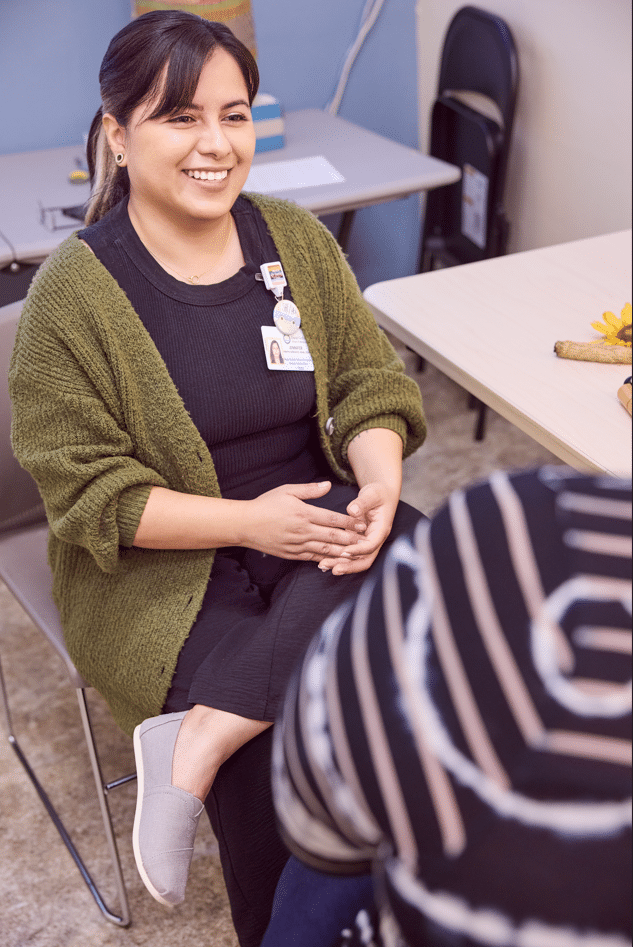
Here’s how Venice Family Clinic therapists deliver cutting edge trauma care.
News of group sexual violence on a college campus shook Elena* to her core when it appeared on her social media feed. It reminded her of the dangerous environment for women that she grew up in that had contributed to years of depression and self-harm.
“Before our work together processing her traumatic upbringing and moving into healing, Elena would have shut down hearing news like this,” said Nisa Baty, Elena’s therapist and Venice Family Clinic’s director of behavioral health. “She might have returned to self-injurious behavior including cutting, and she may have isolated, finding it difficult to leave her home.”
Instead, she brought the current news and her memories to therapy and worked through the feelings. The experience of articulating her emotions made her feel strong and ultimately gave her the ability to simply continue on with the rest of her day.
The lingering effects of trauma
Trauma is the impact that physically or psychologically dangerous events can have on us. Everyone experiences adverse events throughout their lives. But these events can have a residual traumatic impact if a person lacks the necessary safety, support, stable environment and emotional coping skills to process the experience in the moment. Trauma from the past can manifest in how we experience and react to the present.
“Trauma can remain embedded in our nervous system, which then elicits heightened emotional responses to current events,” explains Baty. “In trauma therapy, we create a space where patients can process their original traumas, so they can regulate their emotional response to current stressful events.”
Unprocessed trauma can impact relationships, cause instability and drive folks to substance use or other unhealthy coping mechanisms. Parents with unresolved trauma can unintentionally pass their trauma on to their children. For example, someone who was hurt as a child when they acted out may have an outsized response when their own child acts out, thus perpetuating patterns of generational trauma. Experiencing trauma in childhood also directly correlates with increased instances of chronic disease in adulthood, according to multiple studies.
Venice Family Clinic patients face financial hardship and housing insecurity and are often members of marginalized populations. This exposure to daily stress, discrimination and violence can cause and be compounding factors for trauma. This is why all Venice Family Clinic therapists practice multiple modalities of trauma-informed therapy.
Helping Venice Family Clinic patients break the cycles of trauma
Venice Family Clinic therapists use trauma-informed cognitive behavioral therapy (T-CBT), trauma recovery psychotherapeutic approaches, internal family systems therapy, EMDR and more. These methodshelp patients reconcile their past and repair relationships so they can move through their current lives with resilience and support.
One patient with whom Baty employed these methods experienced significant abuse in her marriage. By engaging in trauma counseling with Baty, as well as domestic violence counseling and substance use treatment, she shifted her coping mechanisms from numbing, isolation and avoidance to healthy coping, empowerment and strong boundaries with family and community. Recently, she received a difficult medical diagnosis – something Baty said might have previously triggered her past harmful habits. Instead, she is on top of her treatment, continues to be an advocate for other women and accepts loving help from her daughters.
Some Clinic therapists employ somatic therapy, which helps patients recognize how trauma is stored in the body. This allows them to find healing through physical and emotional integration, release and sensory awareness.
For example, when traumatic memories or feelings surface for a patient, a somatic practitioner will ask them what they notice or where there may be tension in the body. Therapists will help the patient tune in to the messages of their body and then guide the patient in muscle relaxation strategies and/or breath work. This supports a sense of emotional regulation and calmness while processing traumatic memories. Remarkably, resolving physical tension can lessen the power of a traumatic memory.
Another somatic technique involves teaching patients how to cope using sensory experiences, such as listening to music. Soothing sensory input can calm the patient’s mind, so they have space to consider and process the memory in a new light.
EMDR is a modality that helps the brain re-process a traumatic memory through neurological input like rapid eye movement and body taps. Venice Family Clinic therapists received group training in this specialized modality, and therapist Pablo Orozco-Castro is an advanced EMDR practitioner and Consultant In-Training with EMDRIA (EMDR International Association), which enables him to offer consultations to other therapists that expand the practice of this method to even more patients.
“Trauma is real, and it can impact us in different ways,” Orozco-Castro said. “But we don’t have to let it control us, and that’s what I work on with my patients.In my work, I want my patients to know that there is hope.”
Orozco-Castro practiced EMDR with an adult patient who would react with anger and aggression when she felt threatened, stemming from traumatic parental abuse that affected her ongoing sense of safety. Recently, when the patient felt threatened by an aggressive passenger on public transportation, she was able to react calmly and even advocate for the safety of fellow passengers rather than responding with her own aggression as she might have in the past.
Providing cutting-edge care for all
Orozco-Castro and Baty stress that being able to offer multiple modalities is important because not every patient will respond to the same treatment in the same way. EMDR is a specialty modality, making it hard to access through insurance and consequently financially inaccessible to many folks. Baty sees utilizing cutting edge therapeutic approaches to healing and having a staff who are well-versed in flexible approaches to health, healing and care as essential to Venice Family Clinic’s mission of health care for all.
“Every human has equivalent value and deserves access to quality care,” Baty said. “The goal of behavioral health at Venice Family Clinic is to support people in achieving their highest level of functioning and wellness.”
* Name withheld for patient privacy.