
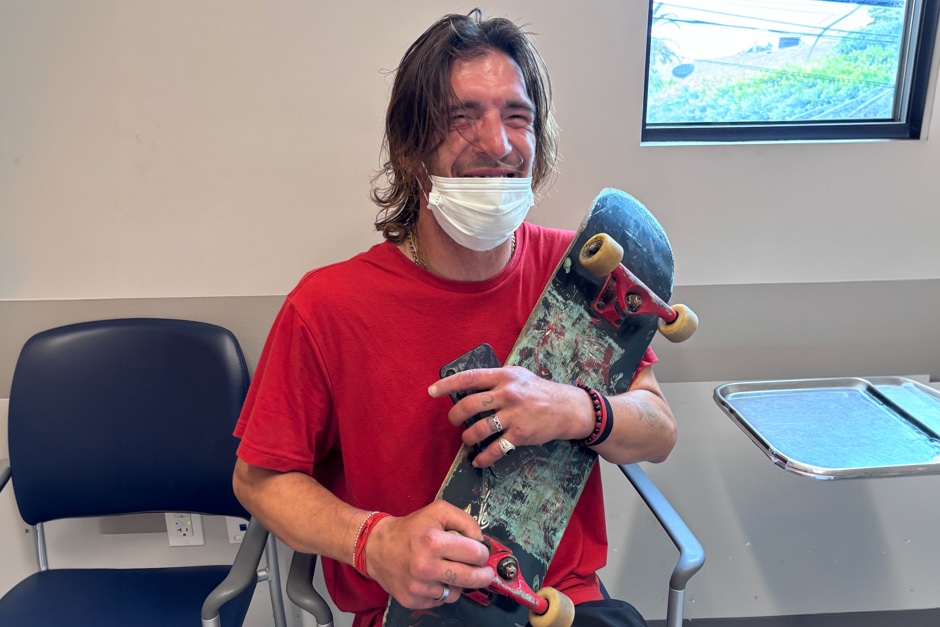
Housing – with health care – opens the door to a second chance.
Christian Schatz, 36, had been living in a tent encampment at La Tijera and the 405 freeway when he decided he just couldn’t go on being sick all the time. His longtime partner, Alice, had just passed away from illness, and Schatz felt unmoored without her. So when outreach and medical representatives from Venice Family Clinic arrived for their biweekly visit to check on encampment residents, he decided to come out of his tent.
Over the next few months, Venice Family Clinic became a lifeline for Schatz, helping him restart HIV medication and treat numerous infections.
“I told [Venice Family Clinic nurse practitioner Hung Le] the day he brought the HIV medication to me, ‘man, you changed my life’,” Schatz said.
Schatz also met with Venice Family Clinic’s Health Insurance Enrollment team to get health insurance coverage. After years of relying exclusively on ER visits for medical care, he now had medication, insurance and clinicians who knew him in Venice Family Clinic’s Gilmore Chung, MD, and Hung Le, NP.
“He is a very motivated patient, just with a lot of medical challenges,” Le said.
In late May, Schatz got life-changing news: He would be getting into housing after nearly a decade of living on the street. Overall, 29 people from the La Tijera encampment would be moved into interim shelter.
But how would he continue to get his medication? He had no phone, so he couldn’t tell his clinicians where he was headed. Housing representatives visited Schatz’ encampment over Memorial Day weekend to coordinate the details, and a few days later, he moved.
By the time Le came to his scheduled visit to Schatz’ tent, the encampment was gone.
More Action Than Communication
Venice Family Clinic Director of Homeless Healthcare Coley King, DO, has been working with housing and health care agencies for years as they attempt to move Los Angeles’ homeless residents into housing. King typically gets somewhere between a couple weeks to a couple days’ notice that his team’s patients are going to be moved from their tents, from whoever happens to give King a heads up in each case. Sometimes they’ll tell him where his patients will be housed, but not always.
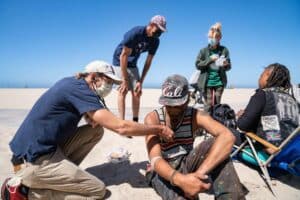
Dr. Coley King, director of homeless healthcare at Venice Family Clinic, treats a patient on the beach.
Encampment sweeps that connect residents to social services and housing have increased since the beginning of Mayor Karen Bass’ Inside Safe program in 2023 and the 2024 Supreme Court ruling that legalized anti-camping enforcement. Le has noticed an uptick in the last six months – perhaps leading up to the World Cup. Chung (and other experts) expect still more before the 2028 Los Angeles Olympics, as has historically happened in other cities hosting the international games.
As these operations have become more common, King and his street team colleagues, including Chung and Le, lament that a more established process to ensure continuity of care hasn’t come with the beefed up sweep operations. In fact, as the scale of these operations have increased, more agencies and organizations involved has meant even muddier waters.
For example, in some cases when a Venice Family Clinic street medicine patient gets housed after an encampment sweep, their medical care legally shifts from Venice Family Clinic to the organization contracted to provide medical care at their housing site. But fractured communication between organizations often means the new medical provider may not have the patient’s medical history or know who their previous provider was to try to get it.
“There are a lot of organizations doing a lot of good things trying to take care of people in myriad ways,” Chung said. “But the organizations don’t necessarily talk to each other. It’s not good for our patients’ health.”
Recently, Chung had just diagnosed one unhoused couple with syphilis when their encampment was cleared, leaving Chung no way to continue their care. Nine months later, he ran into the couple at a motel where he happened to be making room calls. He was relieved – he could finally treat their syphilis, for which they hadn’t gotten treatment in the interim. This was a happy outcome for Chung, who more often worries about whether his lost patients are back on the street, in jail or dead.
“We’re never going to say, ‘don’t get somebody housed,’” Chung said. “But there needs to be a structured process to follow up with the organization that’s been providing their medical care.”
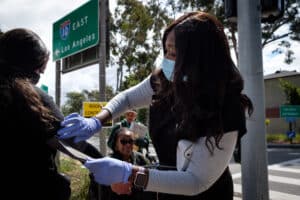
Ebony Funches, DNP, FNP-C, AG-ACNP-BC, PMHNP-BC, treats a patient experiencing homelessness near the 10 freeway.
Searching for a lost patient
In a visit to the La Tijera encampment the week before Memorial Day Weekend, King learned from his patients that they’d be getting housing. He shared this with Chung and Le, who immediately became worried about their patients—especially Schatz. Would he be able to continue following and delivering the regimen of medication treating his HIV? Would Schatz regularly take the medication treating the bartonella infection on his chin and the prophylactic antibiotics preventing life-threatening lung infections?
Because the La Tijera encampment site straddled a freeway and multiple jurisdictions, city, county and state agencies were all involved. This unusual arrangement meant King did not receive the usual tip off from the partner organizations who conduct operations on the Westside. So King started making phone calls, and eventually, the week of the sweep, got a list of the encampment residents who would be moved to an interim housing site east of LAX and south of Crenshaw. Schatz was on the list.
The list also included an email for someone who would help medical providers get in touch with their patients. Le immediately reached out, but got no response. It took multiple attempts over two weeks to finally confirm Schatz’ location and how to contact him.
When Le spoke with Schatz on the phone, they planned for Schatz to come to Venice Family Clinic, 14 miles from his new home. Despite the distance, Schatz committed to coming in because he knew his medicine was live-saving – and he needed it.
Experiencing wrap-around care
On the morning of Schatz’ appointment, Le and his medical assistant waited nervously. The minutes ticked by until finally they received a call from the front desk—Schatz had arrived. Le and the MA whooped with relief.
“Get his height and weight, I don’t think we’ve ever been able to take those measurements before,” Le told the MA as she went to greet him. “I’ve only ever seen him on the side of the road.”
They checked in and took labs, consulted with Venice Family Clinic’s HIV experts on recommended courses of action, fit in a visit with Health Insurance Enrollment to complete paperwork, provided Schatz with food vouchers and filled prescriptions at the pharmacy. His care team asked how Schatz was doing.
“I’m a little lonely,” Schatz said. He had ridden the bus and mostly skateboarded all 14 miles to come in.
Le was relieved that Schatz was staying committed to his health care. Le would still need lab results to see how Schatz’ HIV and infections were faring, but thought that Schatz was doing great in terms of adhering to medication and communicating with the Clinic about side effects and other needs.
“I have a lot of hope that he’s going to do quite well and be in a much better place, maybe in 6 months to a year, not only in terms of his physical health but also the psychosocial components, too” Le said.
Sitting in a Venice Family Clinic exam room that day for the first time, Schatz felt overcome by the care he was receiving.
“I had no idea they were going to do all this,” Schatz said.

A Venice Family Clinic mobile van dispatched to St. Margaret’s Center.
A fresh start
Schatz moved from North Carolina to Los Angeles with Alice nearly a decade ago. Her veterans’ housing fell through as soon as they arrived, and they lived together in tents on the street for nearly a decade.
Alice was the center of Schatz’ world, and without her, he feels a bit lost. But with housing and his health the best it’s been in years, Schatz feels blessed to have a second chance. Now, he can think about what he’s going to do with his life instead of worrying where he’s going to sleep.
“I could be very, very sick right now,” Schatz said. “If it wasn’t for Venice Family Clinic coming to my door, I probably wouldn’t even have gotten housing, because I would have been sick and in the hospital.”
Schatz attributes his change in his attitude and prospects for his future to the medical care he gets from Le and Chung and their dedication to his health.
“They fought for me, and that really made me want to fight for myself too,” Schatz said. “Now, I have the world in front of me.”