
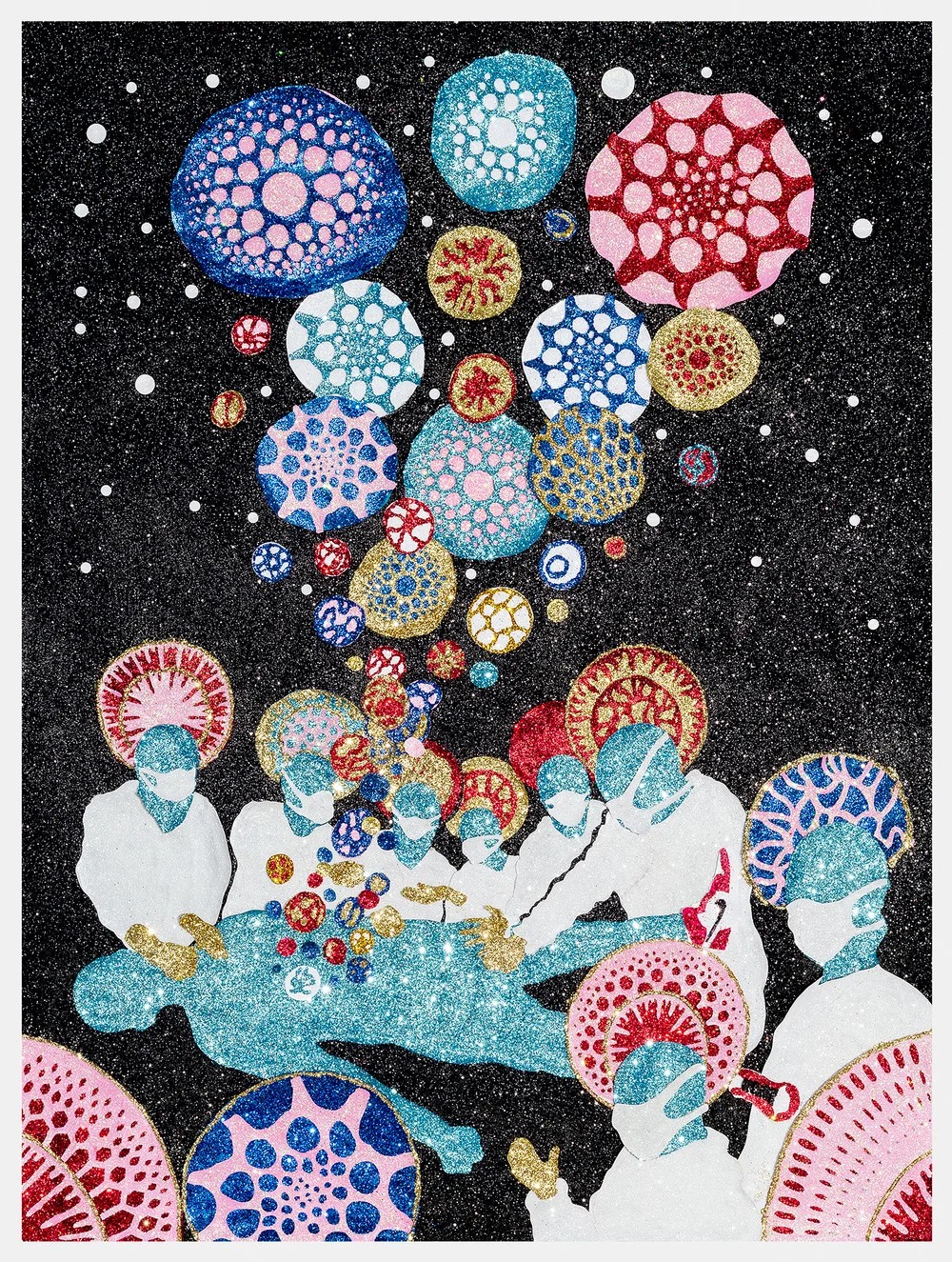
Having an open dialogue and caring for a whole person’s experience in health care are important in both medicine and art.
Living with a chronic illness means spending a lot of time in medical spaces. Artists Annika Klein and Dylan Mortimer, who both live with chronic illnesses, have found art to be a vessel to personally explore and encourage conversation about chronic illness and how medical spaces and our health care system make patients feel.
“I have spent much of my life in hospitals, often in settings with many white walls,” Mortimer says. “Where else but in those vulnerable spaces do people need more help, inspiration and dignity?”
Help, inspiration and dignity is what Venice Family Clinic strives to provide our patients, and we believe art has a role to play. At the Clinic, our artistic community helps us care for patients: Proceeds from the first Venice Art Walk in 1979 kept our doors open to patients, including artists in the community. Additionally, prints of the signature works from 47 years of exhibitions adorn our Clinic walls, fostering a more inspiring and welcoming environment. But more than for aesthetics, we believe that art and healing go hand in hand — caring for the body, mind and soul.
That’s just one of the reasons we’re proud to feature Annika Klein and Dylan Mortimer in this year’s Venice Family Clinic Art Exhibition + Auction, along with 200+ other artists. The themes of healing, sickness and care are frequently the subjects of their works, and they spark important conversations about what it is like to live with a chronic illness.
Annika Klein’s waiting game
When Klein was in her mid-20s, new acute symptoms disrupted her life. In the years since, she has been working with doctors to identify and treat a changing set of autoimmune disorder symptoms. The loss of control she felt over her health soon began to feature in her work.
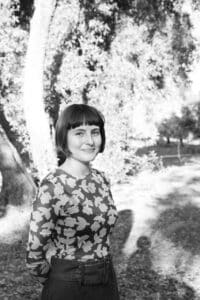
Artist Annika Klein
Photo: Elizabeth Herring
“So much of dealing with any chronic health issue is waiting,” Klein says. “That sense of time and repetition were the drivers behind ‘Taking Care.’”
‘Taking Care’ is Klein’s acclaimed series of intricately painted medical scenes like allergy tests, waiting rooms and blood vials. She has shown pieces from ‘Taking Care’ in past Venice Family Clinic art exhibitions. The works explore the alienation Klein felt in medical spaces as well as the experience of receiving treatment for chronic illness.
The pieces began as photographs of sterile exam rooms and clinical objects. Then, she imbued the experience of waiting as she made painted versions of the photos, with painstaking brush strokes and detail representing the experience of getting care as a person with a chronic condition.
This unexpected combination of medium and subject sparks conversation, even with people who have shied away from discussing their own medical experiences.
“I have people come to my studio and tell me stories of their challenges,” Klein says. “When they’re looking at my work, they feel like they can talk about things that maybe they haven’t shared with others.”
Klein’s Untitled work in his year’s exhibition considers the artist (or patient) in relation to medicine. It features a page from a life sciences textbook collaged over with a silhouette reference from Diego Velázquez’ Las Meninas. Klein describes Las Meninas as a “particularly interesting conversation around the artist claiming power by positioning their body in society,” a theme she carries forward by connecting this historic work with modern medicine.
Dylan Mortimer’s audacious hope
Like others with the genetic disease Cystic Fibrosis (CF), Dylan Mortimer had a life expectancy of just 14 years when he was born. Mortimer has needed lung transplants, and has more recently been undergoing treatment for cancer, which he believes may have been caused by his weakened immune system from CF. Despite these circumstances, and thanks to a combination of significant scientific advances in CF treatment and incredible luck in finding a donor for a second lung transplant after the first did not take, Mortimer is living as a father and artist with a defiant attitude of joy.
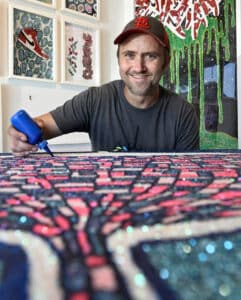
Artist Dylan Mortimer
His artistic medium of choice? Glitter.
“Just like disease, glitter is dirty, annoying and spreads everywhere,” Mortimer explains. “We hate it. And yet glitter is also beautiful, much like the stories of overcoming disease. I use it in a maximalist baroque manner to give a sense of aggressive joy and even offensive hope. The kind of hope it has taken to overcome my many life-threatening health challenges.”
Mortimer weaves images of pills and cells and lungs with trees and basketball shoes and sunshine. His art reflects the duality of living with a chronic condition – trying to survive at the same time that you’re also trying to live. The piece featured in this year’s exhibition, Burning Bush, explores the theme of survival and rebuilding under duress.
“I witnessed the devastation of the Palisades and Eaton fires,” Mortimer says. “But I also saw the resilience of the city – a city that was on fire, but not defeated. This is much like my own life: I have felt on fire throughout it, and yet I have not been burned up. I resonate with this kind of endurance.”
How Venice Family Clinic develops life-long trust for patients with chronic illness
Klein considers herself lucky to have the level of medical care and health insurance that she does. She knows patients with chronic illness, particularly women and women of color, often struggle to get their symptoms taken seriously and to get diagnoses. As a chronic illness patient herself, she has spent time reflecting with her art and otherwise about what medical institutions can do better: increasing access to care, respecting patients’ time, streamlining coordination, and addressing the underlying social factors that can contribute to health and the health of medical systems.
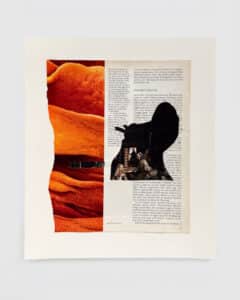
‘Untitled’ by Annika Klein
“How can we improve the systems that lead to unequal outcomes and chronic illnesses?” Klein says. “We need providers who really are able to take the time to listen and have those longer, deeper conversations. Which is a real challenge in our current for-profit medical system, especially when you’re talking about longer-term issues.”
Empowering patients with a medical home that respects their time and autonomy is precisely what Venice Family Clinic is set up to do.
A person with a chronic illness usually has to see a long list of care providers, specialists and coordinators to address their needs, explains Venice Family Clinic Interim Chief Medical Officer Michelle Aguilar, MD. Sometimes, treatment plans or the latest information can get lost in the shuffle between appointments. But Venice Family Clinic uses a “team-based, multidisciplinary care approach,” says Aguilar, intended to streamline care for all patients, including those with chronic conditions. Aguilar says a key component of care for people with chronic illness is that their clinicians know them as whole people, which allows a trusting relationship to develop.
“Really knowing the patient and building that trusted relationship is the most important thing,” Aguilar says. “I can see the difference a trusting relationship makes when a patient doesn’t have that trust with another provider. They’re hesitant to ask questions – so then they bring those questions and experiences back to me, because I’m the trusted clinician.”
It takes time and consistency to build trust. Through our team-based approach that respects a patient’s time and unique needs, Venice Family Clinic strives to make the Clinic feel like a home base for patients with chronic illness. Patients will have a primary care provider, backed by a team who communicates with that PCP. Clinicians, nurses, pharmacists and medical assistants work together on care plans, following the status of referrals and tests alongside the patient. Care is coordinated directly through conversation and documented in our Electronic Health Records system, which allows for accurate histories and notes to follow the patient wherever they go.
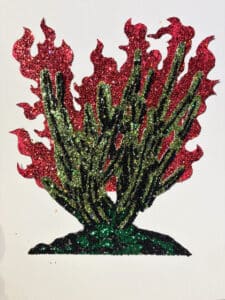
Dylan Mortimer’s ‘Burning Bush’
Meanwhile, support-service teammates such as our case managers, health insurance enrollment specialists and health educators provide further support. Health educators help patients address lifestyle factors that can contribute to health, while case managers ensure people receive the services, resources, and support they need across different providers and settings. For example, case managers will help coordinate transportation for patients to make it to their appointments, arrange interpreters for those who need it, or make sure that people who have to come in for appointments frequently have access to telehealth. The behavioral health team helps patients cope with it all — even, sometimes, through art therapy.
Even with a team at a patient’s back, living with chronic illness involves a life of emotional grappling as much as constantly navigating one’s health care. For Dylan Mortimer, that’s where art comes in.
“My art reflects the despair and sadness of having to endure CF, degenerative disease, chronic illness, two double lung transplants and cancer. But it aims to transform all of those emotions and painful events into joy and hope simultaneously,” Mortimer says. “Both in terms of medical and spiritual care, art has been part of my physical and mental healing.”