

Proponents say the half-cent sales tax is needed to avoid facility closures, mass layoffs, service cuts. Opponents say residents are already taxed enough.
April 22. 2026
by Dan Ross
Originally published in Los Angeles Public Press
A lifetime of hard work and raising two sons alone has caught up with Erika Perez’s health.
Among a long list of issues, Perez, 48, said she has diabetes, weak kidneys, high blood pressure and heart problems. She carries with her a large Ziplock bag crammed full of medications. She said she recently spent 26 days in hospital dealing with Charcot disease, a lower-limb issue stemming from diabetes.
As a cleaner and caregiver with limited wages, Perez relies on Medi-Cal — California’s version of the federal Medicaid low-income program — to cover her many healthcare costs. But Perez said that in mid-March she received a letter warning she’ll soon be ineligible for Medi-Cal. The letter, she said, cited changes to the program stemming from the massive wave of healthcare funding cuts. One set of cuts comes from the federal government via H.R.1, what President Trump called his “One, Big, Beautiful” spending bill passed last year. Thanks to a large budget deficit likely to be exacerbated by H.R.1, California is rolling out its own set of huge Medi-Cal cuts, which has already included an enrollment freeze for undocumented adults.
“When a letter arrives, I’m afraid of opening the envelope because I’m afraid they’re going to tell me I’ve been terminated,” said Perez, who said she’s already started rationing her medications to make them last longer. “I’m worried sick.”
That is why Perez is pinning her hopes on Measure ER on the June 2 ballot that would increase the county sales tax by a half-cent for the next five years, raising potentially $1 billion annually to backfill some of the lost healthcare funding.
Without help, Perez said she has no clue how she’ll pay for her healthcare. “I have a lot of problems,” she said.
Local health officials say LA County could lose an estimated $2.4 billion in healthcare funding over the next three years, triggering a cascading set of facility and service losses in a county where 3.3 million residents are covered by Medi-Cal.
“There’s a lot at stake right now,” said Jim Mangia, president and CEO of the St. John’s Community Health network of health centers and clinics, which, due to the cuts, is facing a federal and state funding hole of one-third of its annual $240 million budget.
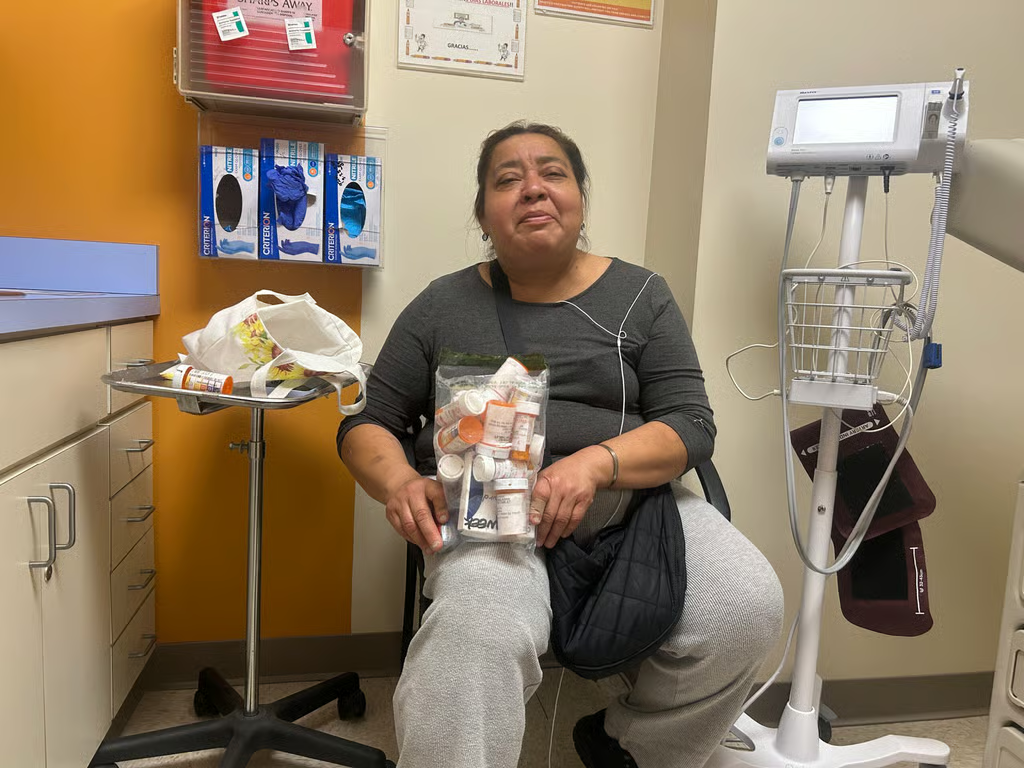
Erika Perez, 48, said she suffers from a variety of health issues including diabetes, weak kidneys and heart problems. But she said she could soon lose her Medi-Cal coverage due to a raft of state and federal healthcare cuts. Photo by Dan Ross.
If the measure doesn’t pass, health officials warn it could lead to the closure of one of the county’s four public hospitals. Potentially 5,000 healthcare-related jobs could be lost. While many healthcare providers aren’t sure yet which of their facilities and services would be axed, one expert suggested satellite clinics, as extensions to larger healthcare systems, would probably be among the first to be consolidated or cut. And with hundreds of thousands possibly set to lose healthcare coverage, the county’s emergency rooms could become overrun, healthcare professionals warn.
But the proposed temporary tax increase arrives when many in the county are already straining under economic hardships. If passed, LA would join Alameda County as the county with the highest sales tax in the state, at 10.25%. It’s currently 9.75%. LA County Supervisors approved the measure for the June ballot when inflation was already on the rise. Since then, President Trump has started a war in the Middle East that has sent gas prices skyrocketing.
“I felt like my back was against the wall,” said LA County Supervisor Holly Mitchell, explaining why she voted to approve the measure. “I could not sit by watching people lose health insurance, knowing that our own health infrastructure was being compromised, and not try to do something.”
In response to concerns about higher taxes, Mitchell added that, relatively speaking, a half-penny on the dollar is a small amount “to stave off calamity.” Because it’s a sales tax, the measure exempts groceries, prescription medications and medical equipment.
LA County is bracing for the worst of the funding cuts
Cuts in federal and state funding started kicking in last year and will continue through October 2028. By March, some 200,000 LA County residents had already been kicked off full-scope Medi-Cal coverage. The worst of the cuts, however, aren’t set to go into effect until the start of next year, after the midterm elections.
“I call this the timeline of terror,” said Louise McCarthy, president and CEO of the Community Clinic Association of Los Angeles County, or CCALAC, which is one of a consortium of healthcare organizations backing the ballot measure. This July, the state is cutting around $1 billion in funding for federally qualified community health centers, she said.
“For LA County, that’s about $400 million every year,” McCarthy said. “And this is just the beginning.”
Measure ER, however, wouldn’t completely fill the funding void.
The revenue generated “will still not be sufficient to sustain the same level of services as currently offered,” wrote Becky Schlikerman, a spokesperson for the LA County Department of Public Health, and Coral Itzcalli, chief communications officer for the LA County Department of Health Services, in a joint statement. This means the seven health clinics the county public health department shuttered in February (citing $50 million in lost revenues) will remain closed.
Mangia said the measure would help the county health department continue to provide vital services like water safety monitoring and addressing the spread of communicable diseases.
“Those are the things we need to preserve and this funding will preserve,” Mangia said.
Other California counties will also vote on a sales tax
LA isn’t the only county turning to a sales tax to protect its healthcare services.
In June, Contra Costa County residents will vote on their own 0.625% sales tax increase that would pull in an estimated $150 million annually over the next five years. Santa Clara County has already made the plunge. In November, voters there approved Measure A, which increased the sales tax by 0.625% (for a total rate of 9.75%) for five years.
That measure passed by a 57.25% to 42.75% margin. A recent poll cited in the Los Angeles Daily News has voters in LA County voting down Measure ER, with 47% opposed and 45% supporting it. The measure needs a simple majority to pass.
Opposition to the measure has largely focused on economics. Kathryn Barger was the lone LA County supervisor to vote against putting the measure on the June ballot, arguing the tax would make the county “less affordable for families and less appealing for consumers to shop and businesses to operate.”
Some individual cities have also been either lukewarm or clearly opposed to the measure.
In Pasadena, which operates its own public health department, the city’s mayor, Victor Gordo, supports the sales tax, but the city council has not taken a position on it. Some council members have voiced concern Pasadena would only get a limited amount back from the $22 million the city is expected to generate.
In March, La Verne City Council formally opposed the sales tax citing transparency concerns over how the money will be used. This follows other critics who have questioned whether the revenues, which go to the county’s general fund, would indeed be spent on healthcare.
Officials who back the measure, however, argue that safeguards are already in place to ensure the money would be spent as intended.
The measure puts in place a nine-member citizen oversight committee to recommend and review expenditures and provide annual reporting to the public. LA County Supervisors also approved a spending plan for the revenues, breaking the revenue pie down into percentages. For example, 45% of the funds would go to non-profit health providers to “furnish no cost or reduced cost care to low-income residents of Los Angeles County who do not have health insurance.”
A spokesperson for Supervisor Holly Mitchell asserted in an email that “the County must follow that spending plan.”
Ripple effects from funding losses
The Venice Family Clinic’s Chuck Lorre Rose Avenue Health and Wellness Center, a few blocks from Venice Beach, has a bright, optimistic feel to it thanks to a makeover paid for by a $7 million donation from the Chuck Lorre Family Foundation in 2022. But the building’s shiny veneer hides a world of worry.
The clinic network, which serves some 45,000 people, approximately 80% of whom are on Medi-Cal, faces federal and state funding losses of about 20% or more of its annual budget.
Venice Family Clinic CEO Dr. Mitesh Popat said he’s already instituted a hiring freeze and significant operational efficiencies in anticipation of the looming cuts. He said he fears if Measure ER doesn’t pass, the healthcare picture for vulnerable residents could come to resemble what he saw during his medical training in disadvantaged parts of India, South Africa, and Honduras, where preventable health issues were often left unattended, leading to massive and costly problems later on.
“You’d have people who come in with a basal ganglia stroke, which means they’re paralyzed, half paralyzed. And why? Because they had high blood pressure,” he said. “They’re going to need in-home support, all kinds of things. They’re going to spend months in the hospital and in rehabilitation, all paid for, by the way, by taxpayers. And it could have been prevented by pennies on the dollar with blood pressure medications.”
Around 11% of the Venice Family Clinic’s revenues are from private and community support. Popat sees room for private philanthropy to fill some of the funding void, but not much.
The state, dealing with a $2.9 billion budget deficit, is exploring alternate revenue generating strategies.
Last week, the state Senate unveiled a budget proposal that includes a requirement for some of the state’s top 1% to 2% largest corporations to contribute to the Medi-Cal costs of their workers, potentially raising between $5 and $8 billion annually. This is because 42% of Medi-Cal enrollees “are full-time workers who are not enrolled in their company’s healthcare plan,” the senate notes.
Rachel Linn Gish, interim deputy director at Health Access California, a non-profit healthcare advocacy group, called it a “fruitful first step in the right direction,” but warned that healthcare-related legislation is often a tough sell in Sacramento.
Jacqueline Ovsepyan, a St John’s nurse practitioner (whose patients include Perez), sees the issue through a different lens — the economic ramifications from potentially thousands of lost healthcare jobs.
“For most providers, this is their primary job,” Ovsepyan said. “What happens when you take someone’s primary source of income away?”